Like the hummingbird sipping nectar from every flower, I fly joyfully…
Like the hummingbird sipping nectar from every flower, I fly joyfully through my days, seeing beauty in everything.
Quotation by Amethyst Wyldfyre
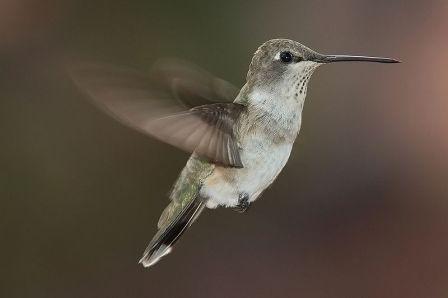
Black-chinned Hummingbird
The Black-chinned Hummingbird (Archilochus alexandri) is a small hummingbird.
Their breeding habitat is open semi-arid areas near water in the western United States, northern Mexico and southern British Columbia.
The female builds a well-camouflaged nest in a protected location in a shrub or tree using plant fiber, spider webs and lichens.
Identification Tips:
• Length: 3 inches
• Long, straight, thin bill
• Small hummingbird
• Bright green back and crown
• White underparts with greenish flanks
Adult male:
• Iridescent purple gorget at lower throat
• Black face, chin, and upper throat
• Entirely dark tail
Female/Immature:
• White chin and throat with variable amounts of thin dark streaking
• Dark tail with white tips on outer tail feathers
Similar species:
Males unmistakable with a good view. Females are similar to a number of other female hummingbirds, and are best told from the Calliope Hummingbird and species in the genus Selasphorus by their lack of rufous on the flanks and in the tail. Anna’s Hummingbirds are larger and have grayer chests, while Costa’s Hummingbirds differ only in subtleties of facial pattern and tail pattern. Black-chinned Hummingbird females are not safely separable from female Ruby-throateds except in the hand. Best told from all species except Ruby-throated Hummingbird by call.
Black-chinned Hummingbirds are migratory and spend most of the winter in Mexico.
These birds feed on nectar from flowers using a long extendable tongue or catch insects on the wing. While collecting nectar, they also assist in plant pollination.
Because of their small size, Black-chinned Hummingbirds are vulnerable to insect-eating birds and animals. This bird is fairly common in its breeding range.
Like the hummingbird sipping nectar from every flower, I fly joyfully through my days, seeing beauty in everything.
Quotation by Amethyst Wyldfyre
Bird Quotation Popularity Poll
(4 answers max)
Loading ...
Add any comments below and/or indicate if you spotted this bird.
Like the hummingbird sipping nectar from every flower, I fly joyfully through my days, seeing beauty in everything.
Bird Quote Notice
Please submit bird quotes, or your own bird quote. Fill out the Submit form on the menu to submit.
Related Blogs
- Ruby-throated Hummingbirds at the Feeder
- Tips for Turning Your Backyard Into a Hummingbird Habitat | Best For Birds
- Broad-Tailed Hummingbirds in Southern Nevada « Mac Danzig Photography
- Peregrine Falcon, Black Nore
- Naturalist: Habitat of Mockingbirds « An Ordinary Guy in an Extraordinary School
- Track The Ruby-throated Hummingbird Migration
- 2007 Ruby-throated Hummingbird Clips 1 | Hummingbird Blog
The hummingbird competes with the stillness of the air
The hummingbird competes with the stillness of the air.
Quotation by Chogyam Trungpa

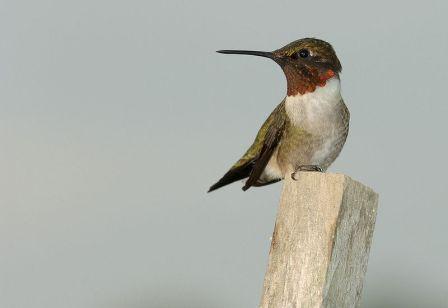
Ruby-throated Hummingbird
The Ruby-throated Hummingbird (Archilochus colubris), is a small hummingbird. It is the only species of hummingbird that regularly nests east of the Mississippi River in North America.
The breeding habitat is throughout most of eastern North America and the Canadian prairies, in deciduous and pine forests and forest edges, orchards, and gardens.
The Ruby-throated Hummingbird is migratory, spending most of the winter in southern Mexico, Central America to South America, and the West Indies.
Identification Tips:
• Length: 3 inches
• Long, straight, thin bill
• Small hummingbird
• Bright green back and crown
• White underparts with greenish flanks
Adult male:
• Iridescent scarlet gorget
• Black face and chin
• Entirely dark forked tail
Female/Immature:
• White chin and throat with variable amounts of thin dark streaking
• Dark, shallowly-forked tail with white tips on outer tail feathers
Similar species:
No other hummingbirds occur regularly over much of its range, but there is some overlap in the southeast and Texas. The Broad-tailed Hummingbird is similar to the male Ruby-throated, but has a rosy-red throat rather than a scarlet or ruby throat patch. Male Ruby-throated Hummingbirds can also be identified by their black face and chin, and their distinctive call notes, and the lack of a wing whistle produced by their wings in flight.
It breeds throughout the eastern United States, and in southern Canada in eastern and mixed deciduous forest. Ruby-throated hummingbirds are solitary.
Nectar from flowers and flowering trees is its main food, but its diet also occasionally includes insects and tree sap taken from woodpecker drilling. It shows a slight preference for red, tubular flowers as a nectar source. The birds feed from flowers using a long extendendable tongue, or catch insects on the wing.
The hummingbird competes with the stillness of the air.
Quotation by Chogyam Trungpa
Bird Quotation Popularity Poll
(4 answers max)
Loading ...
Add any comments below and/or indicate if you spotted this bird.
The hummingbird competes with the stillness of the air.
Bird Quote Notice
Please submit bird quotes, or your own bird quote. Fill out the Submit form on the menu to submit.
Related Blogs
- Killer hummingbirds? « Life, Birds, and Everything
- Broad-tailed Hummingbird « My Earth
- Broad-Tailed Hummingbirds in Southern Nevada « Mac Danzig Photography
- Male Broad-tailed Hummingbird « Ed 's Blog
- Colorado Hummingbird Gallery
- Broad-Tailed Hummingbird in Hannagan Meadow, Arizona
- Santa Cruz County Birding 2/27/10 « The Patagonia Birding & Butterfly Co. : Southern Arizona Bird and Butterfly Watching
I hear like you see — like that hummingbird outside…
I hear like you see — like that hummingbird outside that window for instance.
Quotation by Ray Charles
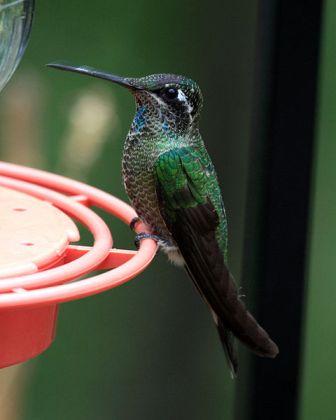
Blue-throated Hummingbird
The Blue-Throated Hummingbird, Lampornis clemenciae, is a species of hummingbird, a member of the Trochilidae family of birds.
The species gets its name from the adult male’s iridescent blue throat patch (gorget), but the female lacks this, having a plain gray throat.
Identification Tips:
• Length: 5.25 inches
• Long, thin bill
• Large hummingbird
• White stripe behind eye
• White malar streak
• Green upperparts
• Grayish underparts
• Black, rounded tail with broad white tips
• United States ranged restricted to southeastern Arizona, southwestern New Mexico and west Texas. Stray elsewhere.
Adult male:
• Blue throat (black in poor light)
Similar species:
The male Blue-throated Hummingbird is unmistakeable. Female is similar to female Magnificent Hummingbird but has large white tips to tail and white malar streak. Other hummingbirds are much smaller.
The Blue-throated Hummingbird is native to mountain woodlands of Mexico. However during summer it is an uncommon resident of moist, wooded canyons in the parts of southeastern Arizona, southern New Mexico, and western Texas and northern parts of Mexico.
Like other hummingbirds, the Blue-throated Hummingbird feeds on nectar from flowers and catches insects in flight and by gleaning from vegetation. In winter, sap from wells drilled by sapsuckers may substitute for nectar.
I hear like you see — like that hummingbird outside that window for instance.
Quotation by Ray Charles
Bird Quotation Popularity Poll
(4 answers max)
Loading ...
Add any comments below and/or indicate if you spotted this bird.
I hear like you see — like that hummingbird outside that window for instance.
Bird Quote Notice
Please submit bird quotes, or your own bird quote. Fill out the Submit form on the menu to submit.
Related Blogs
- Feeder Hummingbirds of the Guatemalan Central Highlands
- Los Quetzales Ecolodge & Spa – Panama Birding Blog › Magnificent Hummingbird
- I hear like you see — like that hummingbird outside that window for instance | Ray Charles
- Mommy & Baby Bunny Rabbit Looking at Red Necked or Throated Hummingbird in Tree – from Hush Little Baby by Artist: Sylvia Long Wall Clock by WatchBuddy Timepieces (White Frame)
- Temperatures rising « stopping by woods
- Bird Watching in Costa Rica – Coming to See the Hummingbirds? | centralamericatravelinfo.com
- Texas A&M News & Information Services » Blog Archive » Butterflies Facing a Tough Journey
Hummingbirds have forgotten the words
Hummingbirds have forgotten the words..
Graffiti at Adelaide, SA – author unknown
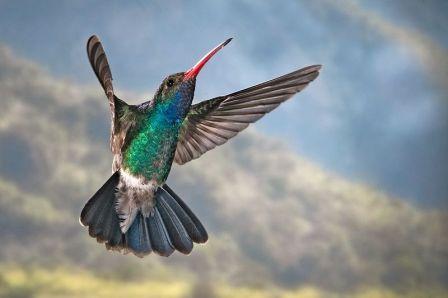
Broad-billed Hummingbird
The Broad-billed Hummingbird, Cynanthus latirostris, is a medium-sized hummingbird. It is 9–10 cm long, and weighs approximately three to four grams.
The breeding habitat is in arid scrub of southeastern Arizona-(the Madrean sky islands of Arizona, extreme southwestern New Mexico and northern Sonora) in the southwestern United States to southwestern Mexico.
Identification Tips:
• Length: 3.25 inches
• Long, thin bill
• United States ranged restricted to southeastern Arizona and west Texas
Adult male:
• Bill has bright red base
• Blue throat
• Green head and body
• White undertail coverts
• Black forked tail
Female/Immature:
• Dark bill with reddish lower mandible
• Thin white line behind eye
• Grayish throat and underparts
• Green upperparts and sides
• Tail has pale outer tips
• Immature male similar to female but may have blue feathers in throat
Similar species:
The female Broad-billed Hummingbird can be told from most other female hummingbirds by it reddish lower mandible. White-eared Hummingbird has a broader white stripe behind the eye.
This hummingbird is partially migratory, retreating from northernmost areas during the winter.
These birds feed on nectar from flowers and flowering trees using a long extendable tongue or catch insects on the wing.
Hummingbirds have forgotten the words.
Graffiti at Adelaide, SA
Bird Quotation Popularity Poll
(4 answers max)
Loading ...
Add any comments below and/or indicate if you spotted this bird.
Hummingbirds have forgotten the words.
Bird Quote Notice
Please submit bird quotes, or your own bird quote. Fill out the Submit form on the menu to submit.