Every bird that upwards swings…

beautiful thoughts


Every bird that upwards swings
Bears the Cross upon its wings

A John Mason Neale or Marcus Valerius Martial Quotation - atributed to both authors

Blue-footed Booby: Have you seen blue-foot lately?

Blue-footed Booby: Have you seen blue-foot lately?

credit +
large image

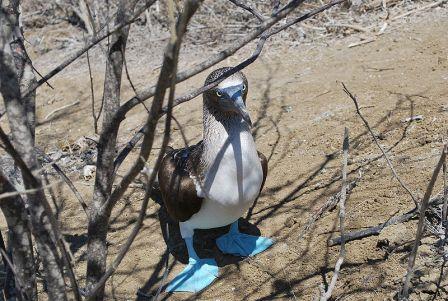
Blue-footed Booby

The Blue-footed Booby (Sula nebouxii) is a bird in the Sulidae family which comprises ten species of long-winged seabirds.

The natural breeding habitat of the Blue-footed Booby is tropical and subtropical islands off the Pacific Ocean, most famously, the Galápagos Islands, Ecuador.

The name booby comes from the Spanish term bobo, which means “stupid” or “fool”/”clown”. This is because the Blue-footed Booby is clumsy on the land, and (like other seabirds), they can be very tame and therefore easily captured, killed, and eaten by humans.

Identification Tips:
• Length: 26 inches Wingspan: 64 inches
• Sexes similar
• Pelagic bird only coming ashore to breed
• Large bird that dives for fish from air
• Takes 2 to 3 years to reach adult plumage

Adult
• Pale, streaked head
• Dark mantle with white patches on nape and rump
• White underparts
• Dark tail sometimes with white patch
• Large, dark, pointed bill
• Blue legs and feet

Immature
• Plumage similar to adult
• Underparts white with straight line between breast and belly

Similar species:
At close range, the blue legs and feet are diagnostic. Immature boobies of other species are very similar to Blue-footed Boobies. Northern Gannets tend to lack the white patches on the nape and rump but at a distance may be inseparable.

Blue-footed Boobies are distributed among the continental coasts of the eastern Pacific Ocean to the Galápagos Islands and California.

The Blue-footed Booby is strictly a marine bird. Their only need for land is to breed, which they do along rocky coasts.

The Blue-footed Booby’s diet consists entirely of fish. Blue-footed Boobies are specialized fish eaters feeding on small school fish like sardines, anchovies, mackerel, and flying fish. They also feed on squid and offal. The Blue-foot dives into the ocean, sometimes from a great height, and swims underwater in pursuit of its prey.


Every bird that upwards swings
Bears the Cross upon its wings.

A John Mason Neale or Marcus Valerius Martial Quotation - atributed to both authors


Bird Quotation Popularity Poll

(4 answers max)

  • Quotation: Every bird that upwards swings...

    View Results

    Loading ... Loading ...

Add any comments below and/or indicate if you spotted this bird.


Every bird that upwards swings
Bears the Cross upon its wings.


pagely468x60_1


Related Blogs

    Read More

    He that will take the bird…


    subliminal


    He that will take the bird must not scare it.

    An English proverb

    Spot-breasted Oriole

    Have you seen this bird?

    Spot-breasted Oriole

    The Spot-breasted Oriole (Icterus pectoralis) is a species of bird in the Icteridae family.

    The Spot-breasted Oriole is found in Costa Rica, El Salvador, Guatemala, Honduras, Mexico, Nicaragua, and the United States.

    Identification Tips:
    • Length: 7.5 inches
    • Sharply-pointed bill
    • Black around eye and throat
    • Black spots on breast
    • Orange face, shoulder, underparts and rump
    • Black back, wings and tail
    • White wing patch and edges
    • Sexes similar
    • Immature similar to adult but duller and lacks breast spots
    • United States range restricted to southeastern Florida

    The Spot-breasted Oriole ranges only on the Pacific Ocean side of Central America. A breeding population has been introduced to, and also exists on the Atlantic Ocean coast of southern Florida.


    He that will take the bird must not scare it.


    Bird Quote Popularity Poll

    (4 answers max)

    • Quote: He that will take the bird...

      View Results

      Loading ... Loading ...

    Add any comments below and/or indicate if you spotted this bird.


    He that will take the bird must not scare it.

    Bird Quote Notice
    If you have or know of a bird quote, bird quotes, or a bird quotation not yet on the site please submit it to Birdquote.com for others to enjoy.


    Large view +
    credit

    Read More

    As the old birds sings…


    subliminal

    As the old birds sings, the young ones twitter.

    A German proverb

    Western Meadowlark

    Have you seen this bird?

    Western Meadowlark

    The Western Meadowlark (Sturnella neglecta) is a medium-sized blackbird, very similar in appearance to the Eastern Meadowlark.

    Their breeding habitats are grasslands, prairies, pastures, and abandoned fields. Their nests are situated on the ground, and are covered with a roof woven from grass.

    Identification Tips:
    • Length: 8.5 inches
    • Sharply-pointed bill
    • Buff and brown head stripes
    • Yellow underparts with black “v” on breast
    • White flanks with black streaks
    • Brown upperparts with black streaks
    • Brown tail with white outer tail feathers
    • Juvenile and winter plumages somewhat duller
    • Frequents open habitats

    Western Meadowlarks are permanent residents throughout much of their range. Northern birds may migrate to the southern parts of their range; some birds also move east in the southern United States.

    The Western Meadowlark is the state bird of Kansas, Montana, Nebraska, North Dakota, Oregon and Wyoming.


    As the old birds sings, the young ones twitter.


    Bird Quote Popularity Poll

    (4 answers max)

    • Quote: As the old birds sings...

      View Results

      Loading ... Loading ...

    Add any comments below and/or indicate if you spotted this bird.


    As the old birds sings, the young ones twitter.

    Bird Quote Notice
    If you have or know of a bird quote, bird quotes, or a bird quotation not yet on the site please submit it to Birdquote.com for others to enjoy.


    Large view +
    Western Meadowlark credits

    Read More

    My father told me all about the birds…

    My father told me all about the birds and the bees, the liar – I went steady with a woodpecker till I was twenty-one.

    A Bob Hope quotation

    Red-bellied Woodpecker

    Have you seen this bird?

    Red-bellied Woodpecker

    The Red-bellied Woodpecker, Melanerpes carolinus, is a medium-sized woodpecker of the Picidae family.

    Identification Tips:
    • Length: 8.5 inches
    • Medium-sized woodpecker
    • Pale gray face, throat, breast, and belly
    • Back strongly barred with black and white
    • Black wings barred and spotted with white
    • White bases to the primaries appear as white crescent in the hand in flight
    • White rump and uppertail coverts with sparse dark markings
    • Dark tail with black and white barring on the central retricies

    Adult male:
    • Red cap extending from bill to nape

    Adult female:
    • Red nape patch, gray crown, and red spot above bill

    These birds mainly search out arthropods on tree trunks. They are omnivores, eating insects, fruits, nuts and seeds. They may also catch insects in flight. Their breeding habitat is usually deciduous forests.

    Predators of adult red-bellied woodpeckers include birds of prey such as sharp-shinned hawks and Cooper’s hawks, black rat snakes and house cats.


    My father told me all about the birds and the bees, the liar – I went steady with a woodpecker till I was twenty-one.

    By Bob Hope


    Bird Quotation Popularity Poll

    (4 answers max)

    • Quotation: My father told me all about the birds...

      View Results

      Loading ... Loading ...

    Add any comments below and/or indicate if you’ve seen this bird.


    My father told me all about the birds and the bees, the liar – I went steady with a woodpecker till I was twenty-one.


    Bird Quote Notice
    If you have or know of a bird quote, bird quotes, or a bird quotation not yet on the site please submit it to Birdquote.com for others to enjoy.


    Large view

    Read More

    God loved the birds and invented trees…


    God loved the birds and invented trees. Man loved the birds and invented cages.

    A Jacques Deval (1890-1972) quotation; a French playwright and director

    Inca Dove

    Identify this bird

    The charming little bird is a bird of Tropical and Lower Sonoran Zones and occurs in the United States only in Arizona, New Mexico, and Texas. Formerly they were confined in southern Texas to the region between San Antonio and the Rio Grande.

    Appearing to delight in human companionship, this cute little bird is rarely found away from towns or the neighborhood of houses. They breed the year round. There is no cessation of nesting because of the fall molt. Males and females alike appear to have no dormant period whatsoever. They almost invariably lay two eggs.

    These birds may be seen in summer singly or in pairs, or rarely in family groups. In fall and winter, however, they gather in small flocks, which sometimes number as many as 50 birds. The call of the bird is a monotonous, unvaried, rather plaintive coo-Gocoo or whoo-oo-wltoo, rapidly repeated over and over. There is a blowing quality to it.


    God loved the birds and invented trees. Man loved the birds and invented cages.

    By Jacques Deval


    Bird Quotation Popularity Poll

    (4 answers max)

    • Quotation: God loved the birds and invented trees...

      View Results

      Loading ... Loading ...

    Add any comments below and/or name the bird.


    Large view

    Read More
    Tweeter button Facebook button Technorati button Reddit button Myspace button Linkedin button Webonews button Delicious button Digg button Stumbleupon button Newsvine button

    Bad Behavior has blocked 360 access attempts in the last 7 days.