I would rather learn from one bird how to sing than to teach…
beautiful thoughts


I would rather learn from one bird how to sing than to teach 10,000 stars how not to dance.

Quotation by E. E. Cummings

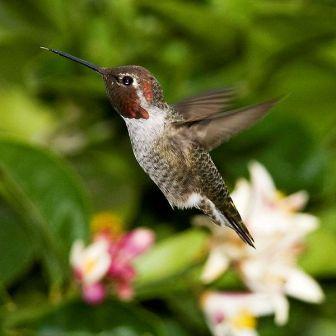
Anna's Hummingbird: Have you seen this bird?

Anna's Hummingbird: Have you seen this bird?

credit +
large image

Anna’s Hummingbird

The Anna’s Hummingbird (Calypte anna) is a medium-sized hummingbird native to the west coast of North America. This bird was named after Anna Massena, Duchess of Rivoli.

Their breeding habitat is open wooded or shrubby areas and mountain meadows along the Pacific coast from British Columbia to Arizona.

Unlike most hummingbirds, the male Anna’s Hummingbird sings during courtship. The song is thin and squeaky. During the breeding season, males can be observed performing a remarkable display, called a display dive, on their territories.

Identification Tips:
• Length: 3.5 inches
• Long, straight, thin bill
• Medium-sized hummingbird
• Green back
• Gray underparts with greenish flanks

Adult male:
• Rosy-red iridescent crown and gorget
• Entirely dark tail

Female/Immature:
• Green crown
• Gray chin and throat with variable amounts of thin dark streaking or rosy red spots depending on age and sex
• Dark tail with white tips on outer tail feathers

Similar species:
Males unmistakable when red crown is seen but beware of poor lighting conditions. Females and immatures are fairly large and gray breasted, and often show the distinctive rosy-red gorget color on the throat. Costa’s and the two Archilochus hummingbirds are the most likely identification contenders, but are smaller with whiter breasts and different call notes.

Anna’s Hummingbirds are found along the western coast of North America, and inland to southern Arizona. They tend to be permanent residents within their range, and are very territorial. However, birds have been spotted far outside their range in such places as southern Alaska, Saskatchewan, New York, Florida and Louisiana.

Anna’s Hummingbirds are the only hummingbirds to spend the winter in northern climates; they are able to do this as there are enough winter flowers and food to support them.

There are an estimated 1.5 million Anna’s Hummingbirds. Their population appears to be stable, and they are not considered an endangered species.


I would rather learn from one bird how to sing than to teach 10,000 stars how not to dance.

Quotation by E. E. Cummings


Bird Quotation Popularity Poll

(4 answers max)

  • Quotation: I would rather learn from one bird how to sing...

    View Results

    Loading ... Loading ...

Add any comments below and/or indicate if you spotted this bird.


I would rather learn from one bird how to sing than to teach 10,000 stars how not to dance.

Bird Quote Notice
Please submit bird quotes, or your own bird quote. Fill out the Submit form on the menu to submit.


reports


Related Blogs

Read More

Don’t the wounded bird still sing

Don’t the wounded bird still sing?

A Sheryl Crow quotation

Common Nighthawk

Have you seen this bird?

Common Nighthawk

The Common Nighthawk, Chordeiles minor, is a nightjar.

Their breeding habitat is open country across North America. They usually nest on bare ground, sometimes in raised locations including stumps or gravel roofs and in burned out forest floors.

Identification Tips:
• Length: 9 inches Wingspan: 23 inches
• Very short bill
• Blackish upperparts with gray and white patterning
• Brown and white patterning on head and chest
• Underparts with heavy dark bars
• Dark wings with conspicuous pale patch midway out from bend in wing
• Dark tail with thin white bars

The birds migrate in flocks. These birds winter in South America. They catch flying insects on the wing, mainly foraging near dawn and dusk.

These nighthawks lay their two eggs directly on bare ground. They do not have a nest.


Don’t the wounded bird still sing?

By Sheryl Crow


Bird Quotation Popularity Poll

(4 answers max)

  • Quotation: Don't the wounded bird still sing

    View Results

    Loading ... Loading ...

Add any comments below and/or indicate if you’ve seen this bird.


Don’t the wounded bird still sing?

Bird Quote Notice
If you have or know of a bird quote, bird quotes, or a bird quotation not yet on the site please submit it to Birdquote.com for others to enjoy.


Large view +
license

Read More

Each bird must sing with…

Each bird must sing with his own throat.

A Henrik Ibsen quotation

Common Ground Dove

Have you seen this bird?

Common Ground Dove

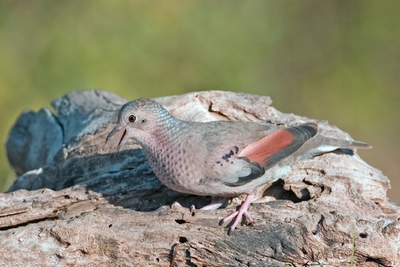
The Common Ground Dove (Columbina passerina) is a small New World tropical dove. It is a resident breeder from Aruba, Bermuda, through the southmost United States, Mexico and the Caribbean, to South America, and is found as far south as northern Brazil.

Common Ground Doves are one of the world’s smallest pigeons, with a length of 17 centimeters (6.5 inches), wingspan of 7.5 cm (10.5 in) and mass of 31 grams (1.1 ounces).

Identification Tips:
• Length: 5.5 inches, wingspan 10.5 in
• Small, chunky dove
• Black-tipped orange bill
• Gray-brown back and upperwings
• Breast and head scaly
• Black spotting on wing coverts
• Cinnamon inner webs of primaries visible in flight, and occasionally at rest
• Cinnamon wing linings
• Short tail is slightly rounded at tip
• Tail is brown centrally, with black edges and white corners
• Juvenile similar to adult female

Adult male:
• Pinkish-buff head, neck and breast
• Pinkish unscaled belly
• Blue hindneck and nape

Adult female:
• Pale gray head, neck, nape, and breast
• Gray unscaled belly

Common Ground Doves feed mainly on seeds, but do eat some insects.


Each bird must sing with his own throat.

By Henrik Ibsen


Bird Quotation Popularity Poll

(4 answers max)

  • Quotation: Each bird must sing with...

    View Results

    Loading ... Loading ...

Add any comments below and/or indicate if you’ve seen this bird.


Large view +
license

Each bird must sing with his own throat.
Read More

We think caged birds sing…

We think caged birds sing, when indeed they cry.

A John Webster quotation

Have you seen this bird?

Have you seen this bird?

Little Auk

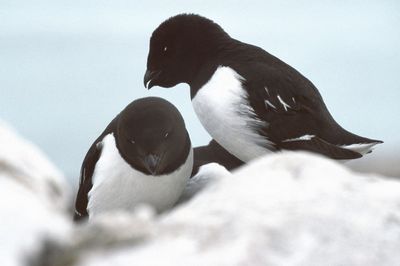
The Little Auk, or Dovekie (Alle alle), is a small auk, the only member of the genus Alle. It breeds on islands in the high Arctic. This is the only Atlantic auk of its size, half the size of the Atlantic Puffin.

Identification Tips:
• Length: 6.75 inches, 12-13 in wingspan
• Sexes similar, short, dark bill
• Immature like basic-plumaged adult
• Very small alcid that dives for food from water surface
• White edges to scapulars
• Thin, white trailing edge to secondaries
• Pelagic bird only coming ashore to breed

Adult alternate
• Blackish head, neck, back, wings, and tail
• White breast, belly, and undertail coverts

Adult basic
• White throat and upper breast
• Whitish crescent on side of neck
• Dark face

The flight is direct, with fast whirring wing beats due to the short wings. These birds forage for food like other auks by swimming underwater. They mainly eat crustaceans, especially copepods, but also other small invertebrates along with small fish. Little Auks produce lots of twitters and cackling calls at the breeding colonies, but are silent at sea.


We think caged birds sing, when indeed they cry.

By John Webster


Bird Quotation Popularity Poll

(4 answers max)

  • Quotation: We think caged birds sing…

    View Results

    Loading ... Loading ...

Add any comments below and/or indicate if you’ve seen this bird.


Large view +
license

We think caged birds sing, when indeed they cry.


Related Blogs

Read More

Sing on, sad bird


subliminal

Sing on, sad bird

Bird Poem

whippoorwill

Whippoorwill

Have you seen this bird?

Sing on, sad bird is the title of a poem by James MacIntosh.

Sing on, sad bird, thou lonely whip-poor-will,
It soothes my grieving breast to hear thy lay;
Each tone that floats o’er forest, vale and hill
Bids Memory gaze upon a happier day.

When Love and Hope sat on this youthful brow
And smiling vowed that we should never part,
Sing on, sad bird, they’re dead and withered now,
Thy mournful notes are balm to this sad heart.

Sing on, sad bird

Enter any comments below and/or name the bird.


Read More

Tweeter button Facebook button Technorati button Reddit button Myspace button Linkedin button Webonews button Delicious button Digg button Stumbleupon button Newsvine button

Bad Behavior has blocked 360 access attempts in the last 7 days.