Duck Definition

Duck Definition

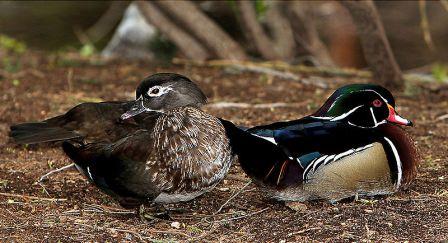
Wood Ducks

Pair of Wood Ducks - click for image credit

duhk

(the bird)

–noun, plural ducks, ( especially collectively for 1, 2 ) duck.
1. any of numerous wild or domesticated web-footed swimming birds of the family Anatidae, esp. of the genus Anas and allied genera, characterized by abroad, flat bill, short legs, and depressed body.
2. the female of this bird, as distinguished from the male. Compare drake1 .

—Idiom
8.
water off a duck’s back, something that has little or no effect: Our criticisms of his talk rolled off him like water off a duck’s back.

World English Dictionary

— n , pl ducks , duck
1. any of various small aquatic birds of the family Anatidae, typically having short legs, webbed feet, and a broad blunt bill: order Anseriformes
2. the flesh of this bird, used as food
3. the female of such a bird, as opposed to the male (drake)
4. any other bird of the family Anatidae, including geese, and swans
8. informal like water off a duck’s back without effect
9. informal take to something like a duck to water to become adept at or attracted to something very quickly

—-


* Above definitions from Dictionary.com


Read More

Always behave like a duck…

beautiful thoughts


Similar Quotations

A Jacob Braude quotation: Always behave like a duck – keep calm and unruffled on the surface but paddle like the devil underneath

A Fred Shero quotation: I’m like a duck: calm above the water, and paddling like hell underneath.


Black Duck female with ducklings

Black Duck female with ducklings

credit + large image

Black Duck

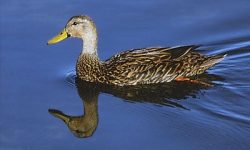
The American Black Duck (Anas rubripes) is a large dabbling duck. The behaviour and voice are the same as for Mallard Drake.

Breeding:
Their breeding habitat is lakes, ponds, rivers, marshes and other aquatic environments in eastern Canada and the Adirondacks in the U.S.
Similar species:
Female, immature and eclipse male Mallards are much paler, with no contrast between head and body. Hybrid Mallard Black Ducks are often seen and usually have traces of the mallard plumage, with bluer speculum usually bordered with white on one or both edges. Mottled Duck is similar. This species is partially migratory and many winter in the east-central United States. These birds mainly eat plants, but also some mollusks and aquatic insects. The Black Duck has long been valued as a game bird, being fast on the wing.


Similar Quotations

A Jacob Braude quotation: Always behave like a duck – keep calm and unruffled on the surface but paddle like the devil underneath

A Fred Shero quotation: I’m like a duck: calm above the water, and paddling like hell underneath.


Bird Quotation Popularity Poll

(4 answers max)

  • Quotation: Always behave like a duck... / I'm like a duck...

    View Results

    Loading ... Loading ...

Add any comments below and/or indicate if you spotted this bird.


Similar Quotations

A Jacob Braude quotation: Always behave like a duck – keep calm and unruffled on the surface but paddle like the devil underneath

A Fred Shero quotation: I’m like a duck: calm above the water, and paddling like hell underneath.


Bird Quote Notice Please submit bird quotes, or your own bird quote. Enter the bird quote for others to enjoy by filling out the Submit form on the menu.


reports


Related Blogs

    Read More

    If you should rear a duck in the heart of the Sahara…

    beautiful thoughts


    If you should rear a duck in the heart of the Sahara, no doubt it would swim if you brought it to the Nile.

    A Mark Twain quote

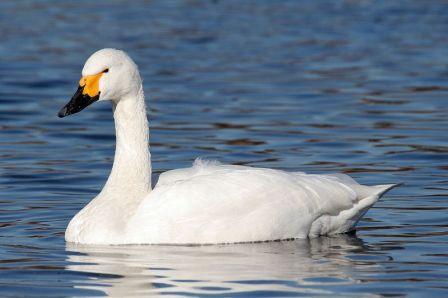
    Bewick's Swan

    Bewick's Swan: Have you seen this bird?

    credit +
    large image

    Bewick’s Swan

    Bewick’s Swan (Cygnus columbianus) is a small Holarctic swan. The two taxa within it are usually regarded as conspecific, but are also sometimes split into two species, Cygnus bewickii (Bewick’s Swan) of the Palaearctic and the Whistling Swan, C. columbianus proper, of the Nearctic.

    Bewick’s Swan is the smallest of the Holarctic swans, in length, wingspan and weight.

    Bewick’s Swans have high-pitched honking calls and sound similar to a black goose (Branta).

    Identification Tips:
    • Length: 36 inches Wingspan: 85 inches
    • Large, long-necked waterbird with short legs and a short duck-like bill
    • Long neck held straight up with a kink at base

    Adult:
    • Black bill with variably-sized yellow spot at base
    • Culmen somewhat concave
    • Black of bill extends up to eye but does not encircle it
    • Straight demarcation on forehead between black bill and white feathering
    • Black legs and feet
    • Entirely white plumage

    Similar species:
    The very large Bewick’s Swan is unlikely to be confused with anything but other swans.

    As their name implies, Bewick’s Swan breeds in the Arctic and subarctic tundra. They inhabit shallow pools, lakes and rivers. These birds are migratory birds. The winter habitat is grassland and marshland, often near the coast. They like to visit fields after harvest to feed on discarded grains and while on migration may stop over on mountain lakes.

    Bird Quote Trivia:

    All of the swans in England are the property of the queen. Disturbing or bothering them is considered a serious offense.


    If you should rear a duck in the heart of the Sahara, no doubt it would swim if you brought it to the Nile.

    A Mark Twain quote


    Bird Quotation Popularity Poll

    (4 answers max)

    • Quotation: If you should rear a duck in the heart of the Sahara...

      View Results

      Loading ... Loading ...

    Add any comments below and/or indicate if you spotted this bird.


    If you should rear a duck in the heart of the Sahara, no doubt it would swim if you brought it to the Nile.


    pagely468x60_1


    Related Blogs

    Read More

    Not the cry, but the flight of the wild duck, leads the flock…

    beautiful thoughts

    Not the cry, but the flight of the wild duck, leads the flock to fly and follow.

    A Chinese proverb

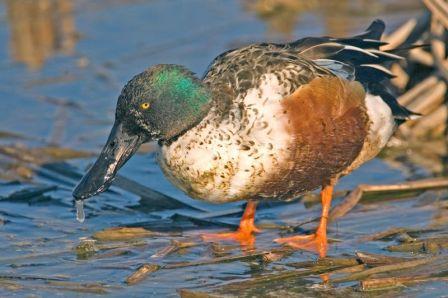
    Northern Shoveler (Anas_clypeata): Have you seen this bird?

    Northern Shoveler (Anas_clypeata): Have you seen this bird?

    credit +
    large image

    Northern Shoveler

    The Northern Shoveler (Anas clypeata), sometimes known simply as the Shoveler, is a common and widespread duck.

    Like most dabbling ducks, it stands well apart from such species as the Mallard and together with the other shovelers and their relatives forms a “blue-winged” group.

    Identification Tips:
    • Length: 14 inches Wingspan: 31 inches
    • Large dabbling duck
    • Large spatulate bill
    • Juvenile similar to adult female

    Adult male alternate:
    • Alternate plumage worn from fall through early summer
    • Black bill
    • Eyes yellow
    • Green head
    • White lower neck, breast, and tail
    • Rusty underbody with white band on hind flanks
    • Dark back, with elongated white scapulars
    • Pale blue upper secondary coverts
    • Green speculum with white leading and trailing edges

    Adult male basic
    • Similar to adult female

    Adult female:
    • Eyes brown
    • Orange bill with dusky patches
    • Mottled brown and buff head, neck and back
    • Dusky blue upper secondary coverts
    • Dull green speculum with white fore border

    Similar species:
    Large, spatulate bill makes the Northern Shoveler immediately recognizable in all plumages.

    This species is unmistakable in the northern hemisphere due to its large spatulate bill.

    It breeds in northern areas of Europe and Asia and across most of North America and is a rare vagrant to Australia.

    This is a bird of open wetlands, such as wet grassland or marshes with some emergent vegetation.

    This dabbling duck is strongly migratory and winters further south than its breeding range. There have been reports of them as far as Australia. The Northern Shoveler is not as gregarious as some dabbling ducks outside the breeding season and tends to form only small flocks.


    Not the cry, but the flight of the wild duck, leads the flock to fly and follow.

    A Chinese proverb


    Bird Quotation Popularity Poll

    (4 answers max)

    • Quotation: Not the cry, but the flight of the wild duck...

      View Results

      Loading ... Loading ...

    Add any comments below and/or indicate if you spotted this bird.


    Not the cry, but the flight of the wild duck, leads the flock to fly and follow.

    Bird Quote Notice
    Please submit bird quotes, or your own bird quote. Fill out the Submit form on the menu to submit.


    reports

    [ad#468x60]


    Related Blogs

    Read More

    Lame Duck

    beautiful thoughts

    Lame Duck

    A saying, quote, dictionary term

    Cultural Dictionary definition
    lame duck

    A public official or administration serving out a term in office after having been defeated for reelection or when not seeking reelection.

    The American Heritage® New Dictionary of Cultural Literacy, Third Edition
    Copyright © 2005 by Houghton Mifflin Company.

    There are several other very similar definitions of this common saying.

    lame duck

    –noun
    1. an elected official or group of officials, as a legislator, continuing in office during the period between an election defeat and a successor’s assumption of office.
    2. a president who is completing a term of office and chooses not to run or is ineligible to run for reelection.
    3. a person finishing a term of employment after a replacement has been chosen.
    4. anything soon to be supplanted by another that is more efficient, economical, etc.
    5. a person or thing that is disabled, helpless, ineffective, or inefficient.
    6. a person who has lost a great deal of money in speculations on the stock market.

    Origin:
    1755–65

    Related forms:
    lame-duck, adjective
    Dictionary.com Unabridged
    Based on the Random House Dictionary, © Random House, Inc. 2009.

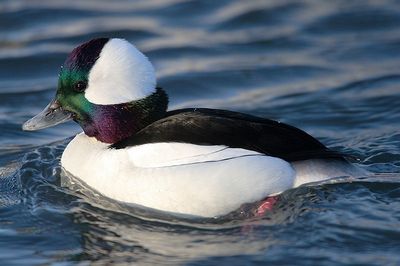
    Bufflehead (duck): Have you seen this bird?

    Bufflehead (duck): Have you seen this bird?

    credit +
    large image

    Bufflehead (duck)

    The Bufflehead (Bucephala albeola) is a small American sea duck of the genus Bucephala, the goldeneyes.

    The name Bufflehead is a combination of buffalo and head, referring to the oddly bulbous head shape of the species. This is most noticeable when the male puffs out the feathers on the head, thus greatly increasing the apparent size of the head.

    The Bufflehead are migratory. Most of them winter in protected coastal waters, or open inland waters, on the east and west coasts of North America and the southern United States.

    Their breeding habitat is wooded lakes and ponds in Alaska and Canada, almost entirely included in the boreal forest or taiga habitat.

    These diving birds forage underwater. In freshwater habitats Bufflehead ducks eat primarily insects. In saltwater this bird feeds predominantly on crustaceans and mollusks. Aquatic plants and fish eggs are often locally important food for them as well.

    They nest in cavities in trees, often using old Flicker or Pileated Woodpecker nests. These old nests are occasionally about 1400 ft from water.

    Buffleheads do not tend to collect in huge flocks. Groups are usually limited to small numbers of less than 10. One duck will serve as a sentry, watching for predators as the others in the group dive in search of food.


    Lame Duck

    A saying, quote, dictionary term


    Bird Quotation Popularity Poll

    (4 answers max)

    • Quote: Lame Duck

      View Results

      Loading ... Loading ...

    Add any comments below and/or indicate if you spotted this bird.


    Lame Duck

    Bird Quote Notice
    Please submit bird quotes, or your own bird quote. Fill out the Submit form on the menu to submit.


    reports

    [ad#468x60]

    Read More

    Bad Behavior has blocked 1124 access attempts in the last 7 days.