A wild goose never reared a tame gosling
A wild goose never reared a tame gosling.
An Irish Proverb quote

Tundra Swan
The Tundra Swan
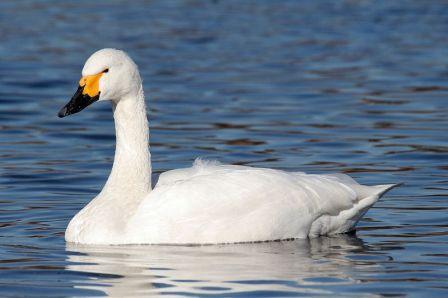
The Tundra Swan (Cygnus columbianus) is a small Holarctic swan. The two taxa within it are usually regarded as conspecific, but are also sometimes split into two species, Cygnus bewickii (Bewick’s Swan) of the Palaearctic and the Whistling Swan, C. columbianus proper, of the Nearctic.
The Tundra Swan is the smallest of the Holarctic swans, in length, wingspan and weight.
Tundra Swans have high-pitched honking calls and sound similar to a black goose (Branta).
Identification Tips:
• Length: 36 inches Wingspan: 85 inches
• Large, long-necked waterbird with short legs and a short duck-like bill
• Long neck held straight up with a kink at base
Adult:
• Black bill with variably-sized yellow spot at base
• Culmen somewhat concave
• Black of bill extends up to eye but does not encircle it
• Straight demarcation on forehead between black bill and white feathering
• Black legs and feet
• Entirely white plumage
• Sexes similar
Immature:
• We are still arguing about this section! Check back later.
• Body grayer than adult
Similar species:
The very large Tundra Swan is unlikely to be confused with anything but other swans.
As their name implies, the Tundra Swan breeds in the Arctic and subarctic tundra. They inhabit shallow pools, lakes and rivers. These birds are migratory birds. The winter habitat is grassland and marshland, often near the coast. They like to visit fields after harvest to feed on discarded grains and while on migration may stop over on mountain lakes.
According to National Geographic, when migrating these birds can fly at altitudes of nearly 27,000 ft. Tundra Swan flocks usually fly in V formation.
A wild goose never reared a tame gosling.
An Irish Proverb quote
Bird Quotation Popularity Poll
(4 answers max)
Loading ...
Add any comments below and/or indicate if you spotted this bird.
A wild goose never reared a tame gosling.
Related Blogs
Read MoreWhen the goose honk high, fair weather…
When the goose honk high, fair weather; when the goose honks low, foul weather.
A proverb

Brant Goose or Brent Goose: Have you seen this bird?
Brent Goose
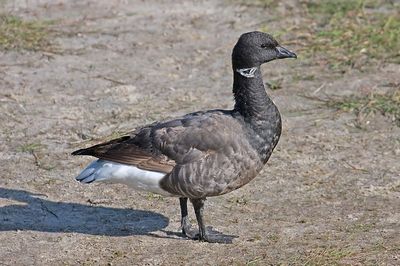
The Brant Goose (Branta bernicla), a goose of the genus Branta, is known in North America as Brant, Brent Goose or Black Brant.
It breeds on the Arctic coasts of central and western Siberia and winters in western Europe, with over half the population in southern England, the rest between northern Germany and northern France.
Identification Tips:
• Length: 17 inches Wingspan: 48 inches
• Sexes similar
• Small coastal goose
• Black head, neck, and breast
• White patch on neck
• Black bill, legs, and feet
• White upper and undertail coverts, rump, and dark tail
• Very dark wings
Adult-Pacific coast
• Very dark back
• Blackish belly
• Some white on flanks
Adult-Atlantic coast
• Dark back
• Pale belly and flanks
Similar species:
Other dark geese have white face patches.
The Brant Goose breeds in Franz Josef Land, Svalbard, Greenland and northeastern Canada. It winters in Denmark, northeast England, Northern Ireland and the Atlantic coast of the U.S.
In recent decades, it has started using agricultural land a short distance inland, feeding extensively on grass and winter-sown cereals.
When the goose honk high, fair weather; when the goose honks low, foul weather.
A proverb
Bird Quotation Popularity Poll
(4 answers max)
Loading ...
Add any comments below and/or indicate if you spotted this bird.
When the goose honk high, fair weather; when the goose honks low, foul weather.
Bird Quote Notice
Please submit bird quotes, or your own bird quote. Enter the bird quote for others to enjoy by filling out the Submit form on the menu.
Read More
The great political tugs of the past 35 years …
The great political tugs of the past 35 years have concerned the distribution of the golden eggs. In the 1980s and 1990s we must focus on the health of the goose.
A Paul Tsongas quotation

Canada Goose: Have you seen this bird?
Canada Goose
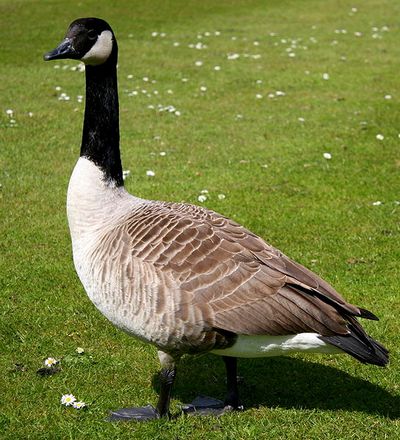
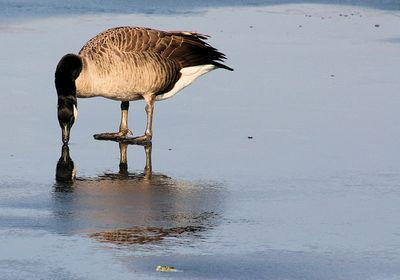
The Canada Goose (Branta canadensis) is a goose belonging to the genus Branta. This goose is native to North America. Frequently it is called the Canadian Goose, however that name is really not correct, according to the American Ornithologists’ Union.
Identification Tips:
• Length: 16-25 inches Wingspan: 50-68 inches
• Large long-necked goose
• Black bill, head and neck
• White throat patch extends up to cheek
• Brown back, upper wing and flanks
• Brownish-white breast and belly
• White upper tail and under tail coverts
• Great size variation
This species breeds in Canada and the northern United States. Usually you will find its nest located in an elevated area. Not just elevated but near water such as streams, lakes, ponds. Sometimes their nest is found on a beaver lodge.
Canada Goose eggs are laid in a shallow depression lined with plant material and down. A very large population of Canada Geese reside in the Great Lakes region.
Canada Geese are herbivores although they sometimes eat small insects and fish. Their diet includes green vegetation and grains such as wheat, beans, rice, and corn when available.
The great political tugs of the past 35 years have concerned the distribution of the golden eggs. In the 1980s and 1990s we must focus on the health of the goose.
A Paul Tsongas quotation
Bird Quotation Popularity Poll
(4 answers max)
Loading ...
Add any comments below and/or indicate if you spotted this bird.
The great political tugs of the past 35 years have concerned the distribution of the golden eggs. In the 1980s and 1990s we must focus on the health of the goose.
Bird Quote Notice
Please submit bird quotes, or your own bird quote. Enter the bird quote for others to enjoy by filling out the Submit form on the menu.
Read More
A market is three women and a goose
A market is three women and a goose.
An old proverb

Ross's Goose: Have you seen this bird?
Ross’s Goose
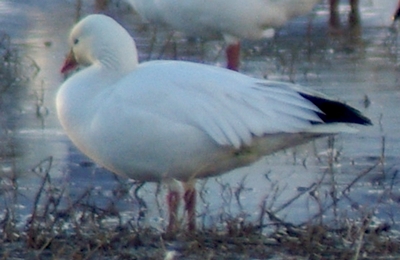
The Ross’s Goose (Chen rossii or Anser rossii) is a North American species of goose.
The Ross’s Goose is a rare vagrant to Western Europe, but is commonly kept in wildfowl collections and so the true frequency of wild birds is hard to ascertain.
Identification Tips:
• Length: 16 inches Wingspan: 51 inches
• Sexes similar
• Small goose
• Different color morphs
• Sometimes hybridizes with similar Snow Goose
White morph-adult
• Entirely white plumage
• Black primaries
• Pink legs and feet
• Pink bill
Blue morph-adult
• White head and upper neck
• Dark lower neck and body
• Pale gray wing upperwing coverts
• Scapulars dark-centered with white edges
• Mostly dark primaries and secondaries
• Pink legs and feet
• Pink bill
Similar species:
White morph Ross’s Goose is extremely similar to the white morph Snow Goose. The Ross’s Goose is smaller with a stubbier bill without the black patch on the mandibles. It also appears rounder-headed with a shorter neck. Immature white morph Snow Goose is darker-backed than the immature white morph Ross’s Goose. The rare blue morph of the Ross’s Goose can be separated from the similar blue morph of the Snow Goose by the same structural characteristics already mentioned. Hybrids between Ross’s and Snow Geese have intermediate characteristics.
This goose breeds in northern Canada, mainly in the Queen Maud Gulf Bird Sanctuary, and winters much further south in the continent in the southern USA and occasionally northern Mexico.
It is named in honor of Bernard R. Ross, a Hudson’s Bay Company factor at Fort Resolution in Canada’s Northwest Territories.
A market is three women and a goose.
Bird Quotation Popularity Poll
(4 answers max)
Loading ...
Add any comments below and/or indicate if you spotted this bird.
A market is three women and a goose.
Bird Quote Notice
Please submit bird quotes, or your own bird quote. Enter the bird quote for others to enjoy by filling out the Submit form on the menu.
Read More
Kill not the goose that lays the golden eggs
Kill not the goose that lays the golden eggs.
An old proverb

White-fronted Goose: Have you seen this bird?
Greater White-fronted Goose
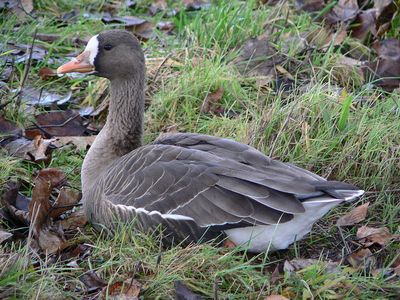
The Greater White-fronted Goose (Anser albifrons) is a goose species closely related to the smaller Lesser White-fronted Goose. In Europe it has been known as simply “White-fronted Goose”.
The Greater White-fronted Goose is divided into five subspecies. All these races are similar in plumage, differing only in size.
Identification Tips:
• Length: 20 inches Wingspan: 60 inches
• Sexes similar
• Medium-sized long-necked goose
Adult
• Mostly brown plumage
• White patch at base of pink or orange bill
• Irregular black spots on belly
• White line separating belly from wings
• White under and uppertail coverts, dark tail
• Orange legs and feet
Similar species:
The White-fronted Goose is the only goose with irregular black spots on the belly and a white patch at the base of the bill. Immatures lack these marks and could be confused with immature blue phase Snow Geese but they have yellowish rather than dark bills, legs, and feet. Escaped domesticated geese can be similar.
The very distinct Greenland White-fronted Goose breeds in western Greenland. It is much darker overall than the other races. It winters in Ireland and western Scotland.
Kill not the goose that lays the golden eggs.
Variation:
Don’t kill the goose with the golden egg.
Bird Quotation Popularity Poll
(4 answers max)
Loading ...
Add any comments below and/or indicate if you spotted this bird.
Kill not the goose that lays the golden eggs.
Bird Quote Notice
Please submit bird quotes, or your own bird quote. Enter the bird quote for others to enjoy by filling out the Submit form on the menu.
Read More