It rolled like water off a duck’s back

beautiful thoughts

It rolled like water off a duck’s back.

A proverb

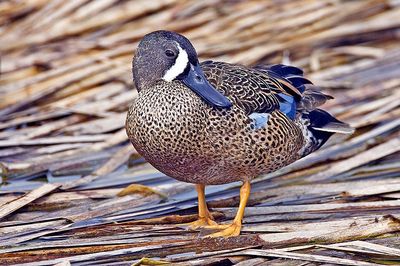
Blue-Winged Teal: Have you seen this bird?

Blue-Winged Teal: Have you seen this bird?

credit +
large image

Blue-Winged Teal (duck)

The Blue-winged Teal (Anas discors) is a small dabbling duck.

Their breeding habitat is marshes and ponds throughout north and central North America. Their range is all of North America except western and northern Alaska, and the highest parts of the continent. They are rare in the desert southwest, and the west coast.

Identification Tips:
• Length: 11 inches Wingspan: 24 inches
• Small dabbling duck
• Medium-sized bill without spatulate tip
• Pale blue upper secondary coverts
• Green speculum with white leading edge
• Dark bill
• Juvenile similar to adult female

Adult male alternate:
• Alternate plumage worn from early winter through early summer
• Blue-gray head with darker cap
• White crescent on face in front of eye
• Buff breast and flanks with darker spotting
• White band at rear portion of flanks
• Black undertail coverts

Adult male basic
• Similar to adult female, but forewing brighter

Adult female:
• Pale head
• Dark crown and eye line
• Pale eye ring, and loral spot
• Mottled gray-brown body plumage with darker back

Similar species:
Adult in alternate plumage is unmistakable. Female, immature and eclipse male similar to Green-winged and Cinnamon Teals. Note the small size and small bill of the Green-winged Teals as well as the green speculum. Cinnamon Teal is very difficult to distinguish in some (female) plumages, but note the smaller bill without a spatulate tip and the more distinct facial pattern (pale loral spot and more distinct eye line) of the Blue-winged Teal.

They migrate in flocks to Central and South America. Some birds winter on the Gulf Coast and coastal California.

Blue-winged Teals feed by dabbling in shallow water at the edge of marshes or open water[2]. They mainly eat plants; their diet may include mollusks and aquatic insects.


It rolled like water off a duck’s back.

A proverb


Bird Quotation Popularity Poll

(4 answers max)

  • Quote: It rolled like water off a duck's back

    View Results

    Loading ... Loading ...

Add any comments below and/or indicate if you spotted this bird.


It rolled like water off a duck’s back.

Bird Quote Notice
Please submit bird quotes, or your own bird quote. Fill out the Submit form on the menu to submit.


reports

[ad#468x60]

Read More

Like a duck out of water

beautiful thoughts

Like a duck out of water.

A proverb

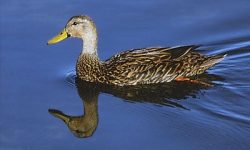
Mottled Duck: Have you seen this bird?

Mottled Duck: Have you seen this bird?

credit +
large image

Mottled Duck

The Mottled Duck (Anas fulvigula[1]) or Mottled Mallard is a medium-sized dabbling duck.

There are two distinct populations of Mottled Ducks. One population, A. fulvigula maculosa (Mottled Duck), lives on the Gulf of Mexico coast. The other, A. fulvigula fulvigula (Florida Duck) is resident in central and south Florida and occasionally strays north to Georgia.

Identification Tips:
• Length: 15 inches
• Sexes similar
• Large dabbling duck
• Yellow bill
• Pale buff brown head
• Darker brown cap and eye line
• Mottled dark brown and buff back and upperwing coverts
• Blue-green speculum with white bar along trailing edge

Similar species:
American Black Duck is similar with broader brown edgings to upperparts and a bluer speculum. Female, immature and eclipse male Mallards always have blue speculums with white borders to both the front and rear margins. Beware of hybrid Mallard x Black Ducks that are usually paler than Black Ducks, with blue speculums and usually with white borders on one or both edges of the speculum.

Along the Gulf of Mexico coast, the Mottled Duck is one of the most frequently banded waterfowl. This is due in part to the fact that the Mottled Duck is mostly non-migratory. Approximately one out of every twenty mottled ducks is banded, making it an extremely prized and sought after bird among hunters.

Mottled Ducks feed by dabbling in shallow water, and grazing on land. They mainly eat plants, but also some mollusks and aquatic insects.

Their breeding habitat is coastal marshes.


Like a duck out of water.

A proverb


Bird Quotation Popularity Poll

(4 answers max)

  • Quote: Like a duck out of water

    View Results

    Loading ... Loading ...

Add any comments below and/or indicate if you spotted this bird.


Like a duck out of water.

Bird Quote Notice
Please submit bird quotes, or your own bird quote. Fill out the Submit form on the menu to submit.


reports

[ad#468x60]

Read More

Happy as a duck in water

beautiful thoughts

Happy as a duck in water.

A proverb

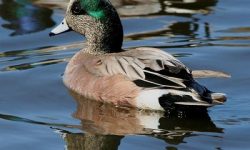
American Wigeon male (drake): Have you seen this bird?

American Wigeon male (drake): Have you seen this bird?

large image

American Wigeon (duck)

The American Wigeon (also American Widgeon or Baldpate), Anas americana is a species of wigeon in the dabbling duck genus Anas.

It is a common and widespread duck. This dabbling duck is migratory and winters farther south than its breeding range.

Identification Tips:
• Length: 14 inches Wingspan: 34 inches
• Large dabbling duck
• Blue bill with black nail
• White secondary coverts (grayer in females) and green speculum
• White axillars
• White belly
• Juvenile similar to adult female

Adult male alternate:
• Alternate plumage worn from fall through early summer
• White crown
• Green post-ocular stripe
• Streaked gray lower face and neck
• Rusty breast and flanks
• Dark brown back
• White patch at rear portion of flanks
• Black undertail coverts

Adult male basic:
• Similar to adult female but usually retains rusty flanks and white forewing

Adult female:
• Blue bill with black tip
• Mottled dark brown body plumage with rustier flanks contrasting with paler head and neck
• Dusky eye patch

Similar species:
Adult in alternate plumage is unmistakable. All plumages distinguished from all other dabbling ducks (except Eurasian Wigeon) by pale gray or white secondary coverts in flight. At rest Wigeon have a distinctive steep forehead and gently sloped rear part of the head, as well as pale blue bills. The rare Eurasian Wigeon is very similar in female, immature and eclipse male plumages and is safely distinguished only in flight by its gray, not white, axillars.

It is a bird of open wetlands, such as wet grassland or marshes with some taller vegetation, and usually feeds by dabbling for plant food or grazing.

It nests on the ground, near water and under cover.

The American Wigeon is a noisy species. It is a rare but regular vagrant to western Europe. It is highly gregarious outside of the breeding season and will form large flocks.


Happy as a duck in water.

A proverb


Bird Quotation Popularity Poll

(4 answers max)

  • Quote: Happy as a duck in water

    View Results

    Loading ... Loading ...

Add any comments below and/or indicate if you spotted this bird.


Happy as a duck in water.

Bird Quote Notice
Please submit bird quotes, or your own bird quote. Fill out the Submit form on the menu to submit.


reports

[ad#468x60]

Read More

No matter how high a bird flies, it has to come down for water


subliminal

No matter how high a bird flies, it has to come down for water.

An old bird proverb

White-tail Kite

Have you seen this bird?

White-tailed Kite

The Common Black Hawk (Buteogallus anthracinus) is a bird of prey in the family Accipitridae, which also includes the eagles, hawks and Old World vultures. The Mangrove Black Hawk, traditionally considered a distinct species, is now generally considered a subspecies, subtilis, of the Common Black Hawk.

The Common Black Hawk feeds mainly on crabs, but will also take small vertebrates and eggs. This species is often seen soaring, with occasional lazy flaps, and has a talon-touching aerial courtship display.

Identification Tips:
• Length: 20 inches Wingspan: 48 inches
• Sexes similar
• Medium-sized hawk
• Broad rounded wings
• Hooked beak
• Short broad tail

Adult:
• Entirely dark plumage
• Yellow legs and cere
• Black tail with broad white band and thin white tip
• Small white base of primaries-not always visible

The Common Black Hawk is a breeding bird in the warmer parts of the Americas, from the southwestern U.S. through Central America to Venezuela, Peru, Trinidad and the Lesser Antilles.

The Common Black Hawk is a mainly coastal, resident bird of mangrove swamps, estuaries and adjacent dry open woodland, though there are inland populations, including a migratory population in northwestern Mexico and Arizona.


No matter how high a bird flies, it has to come down for water.


Bird Quote Popularity Poll

(4 answers max)

  • Quote: No matter how high a bird flies...

    View Results

    Loading ... Loading ...

Add any comments below and/or indicate if you spotted this bird.


Birds of prey do not flock together.

Bird Quotes Notice
We need reader submitted bird sayings, bird quotes, bird poems, bird quotations, or your own bird quote. Click Submit on the menu and enter the bird quotation for others to enjoy.


[ad#468x60]

Large view +
credit

Read More

Bad Behavior has blocked 1158 access attempts in the last 7 days.