Young people on a lark might keep in mind that all birds, except cuckoos…

beautiful thoughts

Young people on a lark might keep in mind that all birds, except cuckoos, build their nests before hatching their eggs.

An anonymous/unknown author quote

Tree Swallow: Have you seen this bird?

Tree Swallow: Have you seen this bird?

credit +
large image

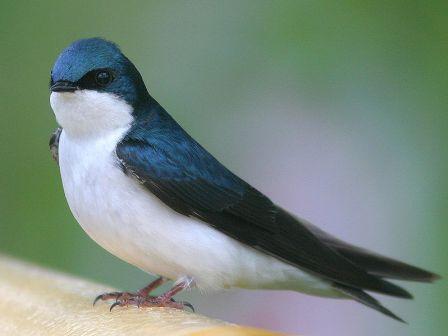
Tree Swallow

The Tree Swallow, Tachycineta bicolor, is a migratory passerine bird that breeds in North America and winters in Mexico, Central America and the Caribbean.

Tree Swallows nest in natural or artificial cavities near water and are often found in large flocks. They readily use nest boxes, including those built for bluebirds.

Identification Tips:
• Length: 5 inches
• Tiny bill
• Iridiscent blue-green upperparts
• White underparts
• Forked tail
• Female duller than male
• Juvenile dull brown above and may have hint of a gray breast band
• Most often seen flying
• Nests in cavities near water
• Often found in large flocks

Similar species:
The Tree Swallow is most similar to the Violet-green Swallow. The Violet-green Swallow has white patches that extend further onto the sides of the rump, a white area that extends behind and over the eye and greener upperparts. Bank and Northern Rough-winged Swallows look similar, especially in Fall. Bank Swallow is smaller, this feature is especially noticeable as mixed flocks of swallows often sit on telephone wires.

Tree Swallows are known to “fight” over feathers in mid-air for reasons which are still under investigation. There is some speculation that this is a form of play.

They subsist primarily on a diet of insects, sometimes supplemented with small quantities of fruit. Tree Swallows are excellent fliers and take off from their perch and acrobatically catch insects in their bills in mid-air.


Young people on a lark might keep in mind that all birds, except cuckoos, build their nests before hatching their eggs.

An anonymous/unknown author quote


Bird Quotation Popularity Poll

(4 answers max)

  • Young people on a lark might keep in mind that all birds...

    View Results

    Loading ... Loading ...

Add any comments below and/or indicate if you spotted this bird.


Young people on a lark might keep in mind that all birds, except cuckoos, build their nests before hatching their eggs.

Bird Quote Notice
Please submit bird quotes, or your own bird quote. Fill out the Submit form on the menu to submit.


reports

[ad#468x60]

Read More

Birds in their little nests agree

Birds in their little nests agree.

A Latin proverb

Rose-breasted Grosbeak

Rose-breasted Grosbeak: Have you seen this bird?

Rose-breasted Grosbeak

The Rose-breasted Grosbeak, Pheucticus ludovicianus, is a large seed-eating bird in the cardinal family.

The Rose-breasted Grosbeak’s breeding habitat is open deciduous woods across most of Canada and the eastern United States. Northern birds migrate to southern Mexico south through Central America to Peru and Venezuela in winter.

Identification Tips:
• Length: 7.25 inches
• Large, conical, pale bill

Adult male:
• Rosy-red, triangular breast patch
• Black head and upperparts
• White underparts
• White patches in wing
• White spots in black tail
• Rosy-red wing linings
• Male in Fall and Winter is duller, browner
• Immature male similar to adult male in Fall and Winter but duller

Adult female:
• Black and white crown stripes
• White underparts with extensive streaking
• Dark gray upperparts
• Yellow to yellowish-orange wing linings
• Immature female similar to adult female
• Juvenile has buffy breast

Similar species:
Female-plumaged Black-headed Grosbeak is very similar to female-plumaged Rose-breasted Grosbeak but has buffier breast and has streaking confined to the sides.

The Rose-breasted Grosbeak forages in shrubs or trees for insects, seeds and berries, also catching insects in flight. In the winter quarters, they can be attracted into parks, gardens, and possibly even to bird feeders by fruit like Trophis racemosa.

Misguided fire prevention policies have created habitat on the Great Plains, thereby allowing the Rose-breasted Grosbeak to extend its range westwards.


Birds in their little nests agree.

A Latin proverb


Bird Quotation Popularity Poll

(4 answers max)

  • Quote: Birds in their little nests agree.

    View Results

    Loading ... Loading ...

Add any comments below and/or indicate if you spotted this bird.


Birds in their little nests agree.

Bird Quote Notice
Please submit bird sayings, bird quotes, bird poems, or your own bird quote. Enter the bird quotation for others to enjoy by filling out the Submit form on the menu.


reports

[ad#468x60]

credit

Read More

Never look for birds of this year…

Never look for birds of this year in the nests of the last.

A Cervantes (Miguel de Cervantes Saavedra) quotation

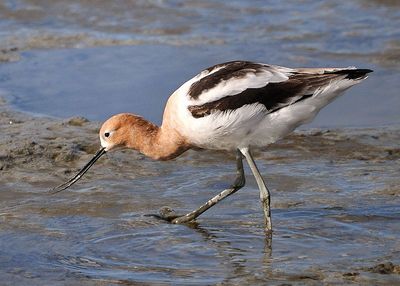
American Avocet

Have you spotted this bird?

This species is migratory, and mostly winters on the southern Atlantic and Pacific coasts of Mexico and the United States.

Identification Tips:
• Length: 15 inches
• Large, very long-legged shorebird
• Long, very thin, upturned black bill
• Blue-gray legs
• White rump and tail
• Sexes similar, but bill is more strongly recurved in female than in male

Adult alternate:
• Rust red head, neck and chest
• White lores and eye ring
• White upper back, breast, belly and tail
• White back is bordered by two long, black stripes on the scapulars
• Black outer wing and white inner wing, with a black bar through middle of inner wing

Adult basic:
• Similar to adult alternate, but head, neck, and chest are grayish

Juvenile:
• Gray face
• Rusty wash on head and hind neck

This avocet has long, thin, gray legs. The plumage is black and white on the back with white on the underbelly. The neck and head are cinnamon colored in the summer and gray in the winter. The long, thin bill is upturned at the end. The adult is about 45 cm (18 inches) tall.

Behavior: Avocets are at all times tame and unsuspicious, very solicitous and aggressive on their breeding grounds, quiet and indifferent at other times, showing only mild curiosity. Their demonstrations of anxiety on their nesting grounds, particularly if they have young, are amusing and ludicrous. Regardless of their own safety, they meet the intruder more than half-way and stay with him till he leaves.


Never look for birds of this year in the nests of the last.

By Cervantes (Miguel de Cervantes Saavedra)


Bird Quotation Popularity Poll

(4 answers max)

  • Quotation: Never look for birds of this year…

    View Results

    Loading ... Loading ...

Add any comments below and/or name the bird.


[ad#468x60]

Large view +
license

Read More

Bad Behavior has blocked 1125 access attempts in the last 7 days.