There are no birds in last year’s nest
There are no birds in last year’s nest.
A Henry Wadsworth Longfellow quotation

Orchard Oriole: Have you seen this bird?
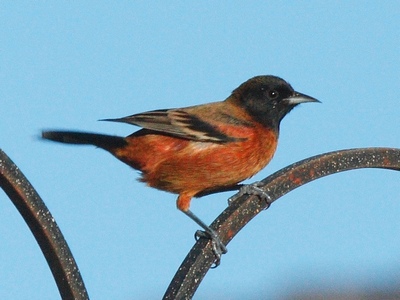
Orchard Oriole
The Orchard Oriole, Icterus spurius, is the smallest species of icterid blackbird at 6.3 inches (16 cm) long. These birds are sometimes mistakenly identified as New World Warblers.
The breeding habitat is semi-open areas with deciduous trees across eastern North America south to central Mexico. These birds enjoy living in shaded trees within parks along lakes and streams.
Identification Tips:
• Length: 6 inches
• Sharply-pointed bill
Male:
• Black head, back, breast, wings and tail
• Brown underparts, shoulder, and rump
• Immature male similar to female but has black throat
Female:
• Greenish-gray upperparts
• Yellowish underparts
• Two wing bars
Similar species:
Male Orchard Oriole is quite distinctive. Female Baltimore and Bullock’s Orioles have grayer bellies than female Orchard Orioles. Female Hooded Oriole very similar but has a decurved bill.
Orchard Orioles depart their winter habitats in March-April and arrive in their breeding habitats in late April-late May. Usually, they leave their breeding territories in late July/early August and arrive on their winter territories in mid August.
While in breeding season, they eat insects and spiders. When the season changes, their diet does as well; to ripe fruit. That quickly passes through their digestive tract. During the winter, their diet consists of fruit, nectar, and insects.
There are no birds in last year’s nest.
A Henry Wadsworth Longfellow quotation
Bird Quotation Popularity Poll
(4 answers max)
Loading ...
Add any comments below and/or indicate if you spotted this bird.
There are no birds in last year’s nest.
Bird Quotes Notice
Please submit bird sayings, bird quotes, bird poems, or your own bird quote. Enter the bird quotation for others to enjoy by filling out the Submit form on the menu.
Read More
A little bird wants but a little nest
A little bird wants but a little nest.
An Arabian proverb

Have you seen this bird?
Magnificent Hummingbird
The Magnificent Hummingbird (Eugenes fulgens) is a large hummingbird that breeds in mountains from the southwestern United States to western Panama.
This bird inhabits the edges and clearings of montane oak forests from about 2000 m to the timberline.
Identification Tips:
• Length: 5 inches
• Long, thin bill
• Large hummingbird
• White spot behind eye
• Dark blackish-green upperparts
• United States ranged restricted to southeastern Arizona and southwestern New Mexico
Adult male:
• Metallic green throat (black in poor light)
• Black breast
• Purple crown
• Gray undertail coverts
• Black forked tail
Adult female:
• Dull gray underparts
• Dark, rounded tail with grayish-white corners
Similar species:
The male Magnificent Hummingbird is unmistakeable. Female is similar to female Blue-throated Hummingbird but lacks large white tips to tail and white malar streak. Other hummingbirds are much smaller.
Food: The food of this species is nectar, taken from a variety of flowers. They also eat some small insects. Magnificent Hummingbird males perch conspicuously and defend their feeding territories aggressively.
A little bird wants but a little nest.
Bird Quote Popularity Poll
(4 answers max)
Loading ...
Add any comments below and/or indicate if you spotted this bird.
A little bird wants but a little nest.
Bird Quote Notice
If you have or know of a bird quote, bird quotes, or a bird quotation not yet on the site please submit it to Birdquote.com for others to enjoy.
Large view +
Magnificent Hummingbird credit
It is a foul bird that fills…
It is a foul bird that fills his own nest.
A proverb

Have you seen this bird?
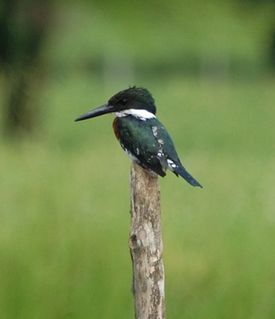
Green Kingfisher
The Green Kingfisher, Chloroceryle americana, is a resident breeding bird which occurs from southern Texas in the USA south through Central and South Americal to central Argentina.
Identification Tips:
• Length: 7.5 inches
• Long, stout bill
• Green crest
• White throat and collar
• Green upperparts with white spotting
• Male has rusty breast, female has dark spotting on breast
• White belly and undertail coverts with dark spots
• United States range restricted to southern Texas
Similar species:
The Green Kingfisher is smaller than other kingfishers and lacks blue-gray coloration.
This small kingfisher breeds by streams in forests or mangroves. The nest is in a horizontal tunnel up to a meter long made in a river bank. Fish is their prey. They also eat aquatic insects.
It is a foul bird that fills his own nest.
Variation:
It’s an ill bird that fouls its own nest.
Bird Quote Popularity Poll
(4 answers max)
Loading ...
Add any comments below and/or indicate if you spotted this bird.
It is a foul bird that fills his own nest.
Bird Quote Notice
If you have or know of a bird quote, bird quotes, or a bird quotation not yet on the site please submit it to Birdquote.com for others to enjoy.
Large view +
Green Kingfisher credit
God gives every bird his worm…

God gives every bird his worm, but He does not throw it into the nest.
A P. D. James quotation

Identify this bird
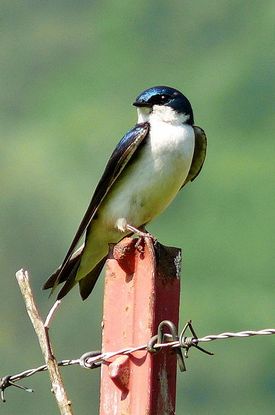
This bird, Tachycineta bicolor, is a migratory passerine bird that breeds in North America and winters in Mexico, Central America and the Caribbean. It is a very rare vagrant to western Europe.
Some characteristics:
* Forked tail
* Length: 5 inches
* Tiny bill
* Iridescent blue-green upperparts
* White underparts
* Female duller than male
* Nests in cavities near water
* Often found in large flocks
It averages 13.5 cm (5 inches) long and weighs about 20g. The bill is tiny. The adult bird has iridescent blue-green upperparts, white underparts, and a very slightly forked tail. The female usually has duller colors than the male, often more greenish than the more bluish male. The juvenile plumage is dull grey-brown above and may have hint of a gray breast band.
The birds nest in natural or artificial cavities near water and are often found in large flocks. They readily use nest boxes, including those built for bluebirds. Declines in cavity-builder populations are resulting in fewer natural nesting sites for these birds.
God gives every bird his worm, but He does not throw it into the nest.
By P. D. James
Bird Quotation Popularity Poll
(4 answers max)
Loading ...
Add any comments below and/or name the bird.
Read More